
In 2018, the Province of Ontario began shifting how new GO stations would be delivered by pursuing opportunities to allow third parties to contribute to station costs. As part of this strategy, the province has developed the Transit Station Charge (TSC) to allow eligible municipalities to help fund the design and construction of new GO stations. The TSC would allow the municipal contribution to be spread across many developments and over many years. Along corridors such as the GO Lakeshore East Extension, where there are many landowners, the TSC provides the opportunity for a broader, municipally coordinated funding approach to advance station delivery.

Transit Station Charge
The Transit Station Charge (TSC) is a fee on new development in proximity to the planned GO Stations along the GO Lakeshore East Extension to Bowmanville that will contribute towards a portion of the design and construction costs.
As per the GO Transit Station Funding Act, 2023, the Region of Durham must pass a by-law to establish the TSC. To pass a TSC by-law, the Act requires the municipality to complete a Background Study and conduct public consultation.
Documents
Station Alignment for the GO Lakeshore East Extension to Bowmanville

What is a Transit Station Charge?
The TSC would be enabled through the GO Transit Station Funding Act, 2023, allowing municipalities to advance new GO Stations by contributing to the design and construction costs upfront, and recovering them over time by collecting a TSC.
The TSC is a fee that is applied to new development surrounding the four proposed GO station sites. Benefits of this new transit service include greater connectivity to transit, resulting in better access to jobs and other opportunities, as well as increased housing supply. Note: The TSC is a fee paid only by landowners, builders, or developers who are creating new buildings.
The four planned GO Stations along the GO Lakeshore East Extension to Bowmanville are:
Thornton’s Corners and Central Oshawa Stations, in the City of Oshawa; and Courtice and Bowmanville Stations in the Municipality of Clarington.
TSC Background Study Project Timeline
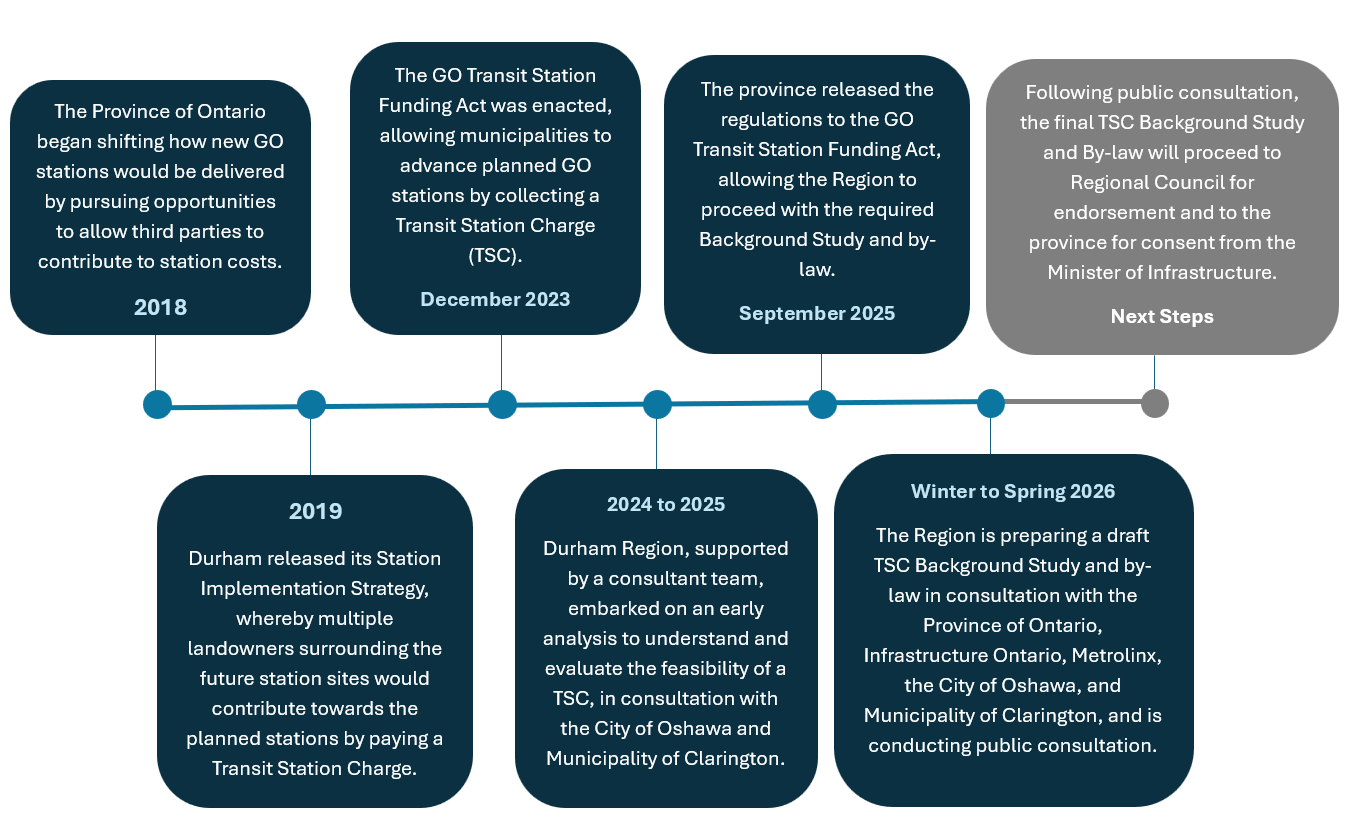
2018
The Province of Ontario began shifting how new GO stations would be delivered by pursuing opportunities to allow third parties to contribute to station costs.
2019
Durham released its own Station Implementation Strategy, whereby multiple landowners surrounding the future station sites would contribute towards the planned stations by paying a Transit Station Charge.
2019-COW-26 - Advancing Rapid Transit Implementation and TOD in Durham
2019 - December 2023
The GO Transit Station Funding Act, 2023 was enacted in December 2023, allowing municipalities to advance planned GO Stations through the collection of a TSC.
2021-P-26 - ROPA 186 to establish Major Transit Station Areas (MTSAs)
2023-COW-11 - March 22, 2023 - Bowmanville GO and TOD
2024
Durham Region, supported by a consultant team, embarked on an early analysis to understand and evaluate the feasibility of the charge for the four planned GO Stations in consultation with the City of Oshawa and Municipality of Clarington.
2025
The Province released Ontario Regulation 207/25 to the GO Transit Station Funding Act, 2023 in September 2025, enabling the Region to proceed with the required Background Study and preparation of a TSC by-law.
Winter to Spring 2026
The Region prepares a draft TSC Background Study and by-law in consultation with the Province of Ontario, Infrastructure Ontario, Metrolinx, City of Oshawa, and Municipality of Clarington, and conducts public consultation on the TSC Background Study and draft by-law.
Next Steps
Following public consultation, the final TSC Background Study and By-law will proceed to Regional Council for endorsement, then forwarded to the province for consent from the Minister of Infrastructure.
I am a local developer in Durham Region, what does this mean for me?
Is this an additional Development Charge?
The TSC is not an additional development charge. Development charges are imposed on builders to fund planned infrastructure such as roads, transit, water and wastewater. By contrast, the TSC contributes to new GO station infrastructure. The contribution amount is based on the benefits obtained by the landowner/developer as a result of the new GO station, such as, improved market demand, and increased development densities due to the transit services.
What are the proposed ‘Transit Station Charge Areas’?
The Transit Station Charge Areas are where the GO Station is forecasted to generate the most significant benefits in terms of new housing and commercial investments.
The Transit Station Charge Areas are located around the planned GO Stations, including the Protected Major Transit Station Areas (PMTSAs) along with a slightly larger surrounding area where the TSC will be applied to new development.
Thornton’s Corners Transit Station Charge Area – Map 1
Central Oshawa Transit Station Charge Area – Map 2
Courtice Transit Station Charge Area – Map 3
Bowmanville Transit Station Charge Area – Map 4
How were the Transit Station Charge Area boundaries determined?
One of the most significant market factors for real estate and housing investment is walkable access to reliable transit. The Transit Station Charge Areas are established based on the forecasted demand for new investment surrounding each station, which is associated with the designated Protected Major Transit Station Areas (PMTSAs), and a slightly larger surrounding area. These boundaries were created in collaboration with area municipalities, and with consideration for streets, highways, natural features, and local zoning provisions.
What is the difference between Zone 1 and Zone 2 of the Transit Station Charge Areas?
There are two zones that make up the Transit Station Charge Areas surrounding each station.
Zone 1 is based on an area described as a Protected Major Transit Station Area (PMTSA) which is a Provincial land use designation that is expected to receive significant development interest as a result of the GO extension. Properties located within the PMTSA have planning permissions to allow higher land use densities.
Zone 2 captures properties within a larger area that are farther away from the station site but are still expected to benefit from the new stations and may not be currently designated for higher density development.
When would the TSC start to be collected?
The charge would be applied to new development once the TSC by-law is passed by Regional Council and has received provincial consent from the Minister of Infrastructure.
When is the TSC payable?
The TSC is payable at the time a building permit has been applied for.
Has this been done anywhere else?
Yes, the principle of requiring developers to pay for or contribute to the cost of transit based on the increased market demand and value for their property is used across the world. In Montreal, a similar charge was recently imposed for development surrounding its new Reseau Express Metropolitain (REM) rapid transit service.
I am a resident who lives close to one of the planned GO Stations.
I don’t plan to develop any part of my property. Will I have to pay this charge?
The TSC only applies to new development within the Transit Station Charge Areas, including any redevelopment projects that create a new unit(s) and/or adds floorspace.
The TSC is only payable at the time of a building permit.
It will not apply to upgrades or renovations of existing homes or floorspace, including new accessory or basement apartment units.
Will I have to pay more property taxes because of the TSC?
No, this charge will not increase property taxes. This new charge will fund the Region’s contribution to the design and construction costs of the four planned GO Stations and thus avoid using property tax revenue.
Will the TSC bring more density to my neighbourhood?
Density targets for Protected Major Transit Station Areas are outlined in the Provincial Planning Statement, 2024, and implemented in each municipality through their official plans and zoning by-laws. The City of Oshawa and the Municipality of Clarington are already planning for transit-oriented densities in these areas through Secondary Plans and other planning policies. The TSC does not introduce new density or as-of-right zoning provisions beyond what is already being planned for by the province, and all new development is subject to local planning and zoning approval processes.
What happens next?
Once the TSC Background Study and by-law are finalized, they will be presented to Regional Council for endorsement. If endorsed, they will be forwarded to the province for consent from the Minister of Infrastructure.
I have questions about how this will impact me. Who can I contact?
You can connect with our team by email: transitstationcharge@durham.ca.
Project Team and Contact Information
Who is leading this project?
This project is being led by the Transit Oriented Development team at the Region of Durham and is supported by multiple internal departments and consultants, including N. Barry Lyon Consultants, Watson & Associates and Bousfields Inc.
Get in Touch
If you would like to learn more about the TSC Background Study and the public consultation process, or if you have questions about how this study may impact you, please reach out to the project team by email: transitstationcharge@durham.ca.
Sign up to our Newsletter
Stay up to date on the Region's activities, events, programs and operations by subscribing to our eNewsletters.