Alcohol

Alcohol and your health

Drinking alcohol has many health risks. They can become worse if you drink alcohol frequently.

Risks include at least seven different types of cancer:

  • Mouth and throat cancer
  • Larynx cancer
  • Esophageal cancer
  • Breast cancer (women)
  • Liver cancer
  • Colon and rectum cancer

Other risks include:

  • Heart disease
  • High blood pressure
  • Stroke

Canada’s Guidance on Alcohol and Health

  • All levels of alcohol consumption are associated with some risk, so drinking less is better for everyone.
  • Among healthy individuals, there is a continuum of risk for alcohol-related harms that depends on how many standard drinks an individual has per week. The risk is:
    • Low for individuals who consume between one and two standard drinks per week.
    • Moderate for those who consume between three and six standard drinks per week.
    • Increasingly high for those who consume more than six standard drinks per week.
  • Although any level of drinking has risk, having more than two standard drinks per week can increase the the risk of injuries or other problems.

Canada’s Guidance on Alcohol and Health

Reduce your risk of alcohol related health problems

Even in small quantities, alcohol can be harmful to your health.

  • Keep track of how many standard drinks you have per week to understand your habits.
  • Set a target to reduce your drinking.
  • Stick to the limits you have set for yourself using Canada's Guidance on Alcohol and Health.
  • Choose drinks with a lower percentage of alcohol.
  • Drink slowly in small sips.
  • Always have water available to you.
  • For every drink of alcohol, have one non-alcoholic drink.
  • Try some alcohol-free cocktail recipes.
  • Never drink and drive or ride with someone who has been drinking.
  • It is okay not to drink alcohol. You don’t need to explain your healthy choices to anyone.
  • 341 ml (12 oz.) bottle 5 per cent alcohol (beer, cider, coolers).
  • 43 ml (1.5 oz.) shot of 40 per cent hard liquor (vodka, rum, gin, whiskey).
  • 142 ml (5 oz.) glass of 12 per cent wine.

Binge drinking means having five standard drinks or more for men, or four standard drinks or more for women in one sitting. It is a pattern of alcohol use that can cause physical, social, and legal harms.  The risk of negative outcomes begins to increase with any amount of alcohol. Drinking large amounts of alcohol in one sitting increases the risk of harms like injuries, accidents, and violence. This is because alcohol can have short-term effects like making it harder to think clearly or do everyday tasks.

Risk of death

Alcohol can lead to serious health problems and increases the risk of death. This includes injuries, violence, heart disease and high blood pressure, inflammation of the gastrointestinal system, and the development of an alcohol use disorder (e.g. alcohol dependence).

Violence, child abuse and neglect

Heavy drinking can harm other people as well as the person who drinks. Examples include violence, child abuse, and neglect. For more information, please visit the Alcohol Harms to Others tab below.

Find more information about other alcohol harms.

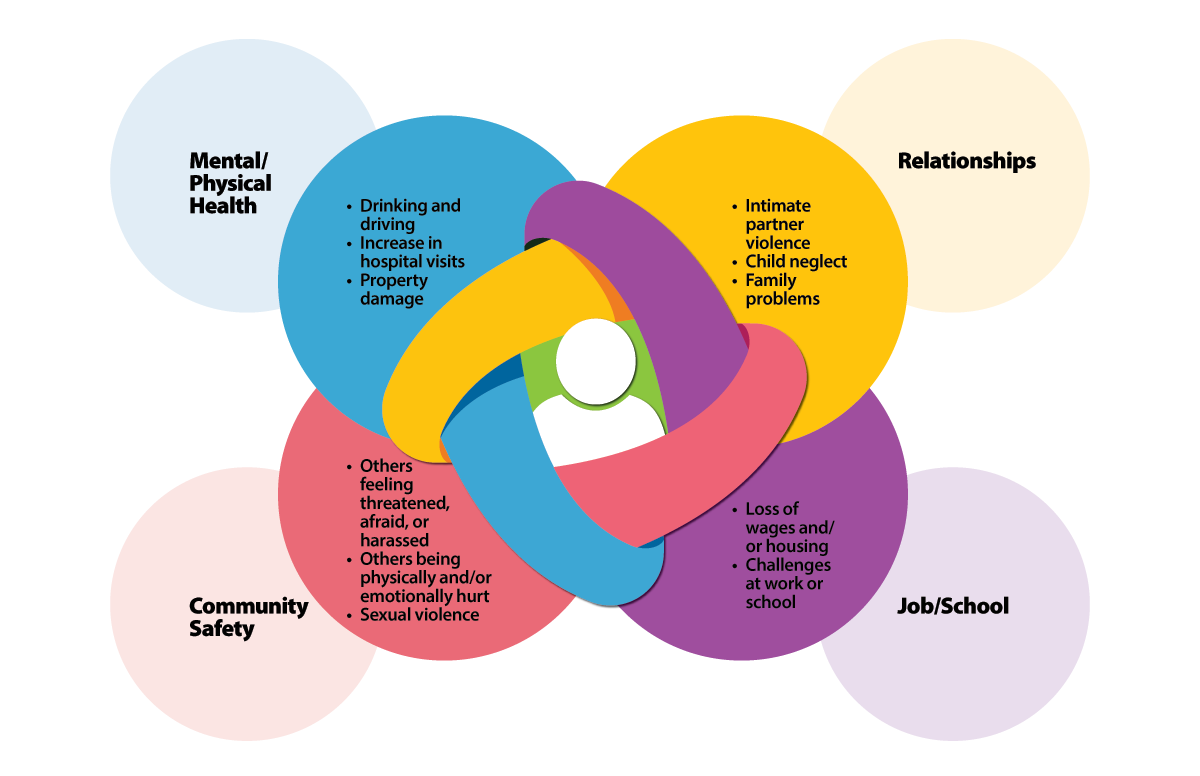
Second-hand alcohol harms are when a person’s drinking affects others. This includes family members, friends, co-workers, neighbours, strangers, and the greater community. Second-hand alcohol harms can happen anywhere and can impact many areas of life.

Some examples include:

Venn diagram showing how alcohol consuption can harm others

Sometimes these impacts reach others quietly, indirectly, and often unintentionally. Drinking less can reduce these harms to others.

It is safest not to drink while pregnant, trying to get pregnant, or for individuals who are breastfeeding.

Family planning can be affected by alcohol use in many ways, such as:

  • Possible increases of miscarriages, high blood pressure disorders related to pregnancy, and risky changes to placental growth and fetal development.
  • Alcohol use can lead to Fetal Alcohol Syndrome which increases the risk for the child to experience lifelong learning, health, and social problems. No amount of alcohol at any time is safe during pregnancy.

Drinking alcohol when you are pregnant or breastfeeding may harm your baby.

Visit our Pregnancy page to learn more about alcohol and pregnancy.

In Durham, 55 per cent of high school students say they drank alcohol in the past year. The legal drinking age in Ontario is 19, but many teens begin drinking between the ages of 13 to 18.

The Real Buzz: Teens and Alcohol

What are the risks for teens that drink?

The brain is still developing until age 25. Teenagers who drink alcohol are at risk for harmful changes in the brain.

Drinking alcohol before the age of 25 may have long-term effects on:

  • Problem solving skills, decision-making and memory.
  • Changes to sleep patterns.
  • Addiction and dependence to alcohol.
  • Chronic diseases such as cancer.

Teens that begin drinking at an early age are at risk of having problems related to alcohol later in life. It's important to delay the initiation of alcohol use.

Heavy drinking can lead to:

  • Trouble in school.
  • Experiences with violence, such as physical or sexual assault.
  • Vehicle accidents, falls, or drowning that cause injuries or death.
  • Risky sexual behaviour.

Support your teen

Here are some ways you can help your teen make healthy decisions around alcohol:

  • Talk to your teen about their thoughts on alcohol.
  • Be informed about what is going on in your teen's life.
  • Remind your teen that not everyone is drinking.
  • Spend time together as a family.
  • Be a good role model for your teen. Make healthy decisions.

Rethink how you drink: Alcohol and aging

As you get older, your body takes longer to process alcohol, so its effects feel stronger. This may cause negative effects, such as:

  • Weaker muscles and poor balance, increasing the risk of injuries due to falls.
  • Worsening of health conditions, such as liver damage, diabetes, heart or blood pressure, stomach conditions.
  • Worsening of mental awareness such as confusion and memory loss.
  • Decreased effects of medications or increased effects of alcohol when taken together.

Older adults may find it difficult to quit drinking even while facing alcohol-related harms in their lives. This could be a sign that they are experiencing alcohol dependence. Signs may include:

  • Difficulty sleeping, eating, taking care of their personal hygiene, and taking routine medications.
  • Becoming easily agitated which may cause tension in their relationships.
  • Making up excuses to defend or hide alcohol use.
  • Loss of interest in hobbies or a desire to be alone.

Long term alcohol use can make it harder for the body to absorb nutrients and can raise the risk of conditions such as, dementia or Parkinson’s disease. Withdrawal symptoms, such as a racing heart rate, tremors, and agitation may occur if someone suddenly stops drinking after long term use.

Consult with a health care professional to determine the best plan to reduce your alcohol use. For more information on healthy aging, please visit our Healthy Aging page.

Curriculum support for educators

Educators play an important role in the health of school communities.

Visit our Educators and Curriculum Resources page for alcohol-related curriculum support resources to assist you in teaching the health curriculum and promoting health and well-being in your school.

For municipal and community planners

When there are bars and/or alcohol stores close together in an area, there are more: People drink more alcohol when there are:
  • Crashes
  • Violence
  • Injuries
  • Heavy drinking
  • Disease and death - especially in communities that may have lower incomes.
  • Many alcohol stores in one area.
  • Alcohol stores with longer hours.
  • Discounted or low-cost alcoholic drinks.
  • Alcohol advertisements.
  • Alcohol sponsored events.

Excessive alcohol consumption costs Ontario’s health care system 7.1 billion dollars annually due to hospitalizations, emergency room visits and long-term care for alcohol-related diseases. Durham Region works with municipalities to create safe communities with strategies that focus on the responsible use of alcohol.

A municipal alcohol policy aims to protect the community's health. Municipal alcohol policies address activities and factors that contribute to alcohol-related issues.

Municipal alcohol policies must use different strategies to work well.

Municipal alcohol policies should include these six key policy components:

  1. Identification of which properties, facilities and events can serve alcohol.
  2. Directions for how alcohol should be handled at events.
  3. Prevention strategies.
  4. Consequences and penalties for not following the policy.
  5. Information to be put on signs.
  6. Policy support.

At A Glance: Eight Steps to Building Healthy Public Policies

See contact information in the section below for support in developing your Municipal Alcohol Policy.

Alcohol Policy Review: Opportunities for Ontario Municipalities

Contact us

Health Department
Durham Health Connection Line
Population Health Division
The Regional Municipality of Durham
605 Rossland Road East
Whitby, Ontario L1N 6A3

Telephone (within regional limits): 311
Email Durham Health Connection Line
Map this location

Sign up to our Newsletter

Stay up to date on the Region's activities, events, programs and operations by subscribing to our eNewsletters.