Data sources
The Ontario Mental Health Reporting System (OMHRS) is an administrative database that provides information about inpatients occupying designated adult mental health hospital beds. This includes general hospitals with designated adult mental health beds, as well as speciality psychiatric hospitals and provincial psychiatric hospitals. The Discharge Abstract Database (DAD) is an administrative database that captures information on acute inpatient hospital care, including day surgery, upon discharge (deaths, sign-outs and transfers). In most cases, DAD collects information on child and adolescent mental health care (approximately two per cent of cases in the OMHRS are individuals under the age of 18).
While OMHRS is an admission-based system and the DAD is a discharge-based system, data from both systems are used to report on mental illness hospitalizations. Both databases submit information to the Canadian Institute for Health Information (CIHI) on behalf of the Ontario Ministry of Health and Long-Term Care (MOHLTC). These rates do not represent the true prevalence of mental illnesses as persons with less severe or undiagnosed mental illnesses are excluded.
The mental illnesses examined in this report were classified according to the Diagnostic and Statistical Manual of Mental Disorders, Fourth Edition (DSM-IV) and according to the International Classification for Diseases, 10th revision, Canadian Enhancement (ICD-10-CA).
For hospital admissions captured in OMHRS, patients with mental illness were selected using the diagnostic categories of substance disorder, psychotic disorder, mood disorder, anxiety disorder or adjustment disorder as the primary, secondary or the tertiary diagnosis. For hospitalizations captured in DAD, patients with mental illness were selected using ICD-10-CA codes F10-F19, F20-F29, F30-F39, F40-F48, F60-F69 as either the primary reason for the hospital stay or a comorbid condition.
An individual may be hospitalized several times each year or in subsequent years for mental illness. As such, the encrypted health card number, a unique number, was used to count the number of individuals discharged at least once from a hospital or admitted at least once to an adult mental health bed on an annual basis.
Data were analyzed by the residence of the individual, not where the hospital admission or discharge occurred. Ontario residents treated outside of the province were excluded. Data were reported by calendar year, based on discharge or admission year of the hospitalization.
This report acknowledges the contribution of Jasantha Naidoo and her report to the Office of the Medical Officer of Health, Peel Public Health, August 2014 as part of her Master of Public Health practicum placement, entitled Analysis of the Ontario Mental Health Reporting System: Examining its Usefulness to Peel Public Health (unpublished).
Definitions
Age-standardized prevalence of mental illness hospitalizations
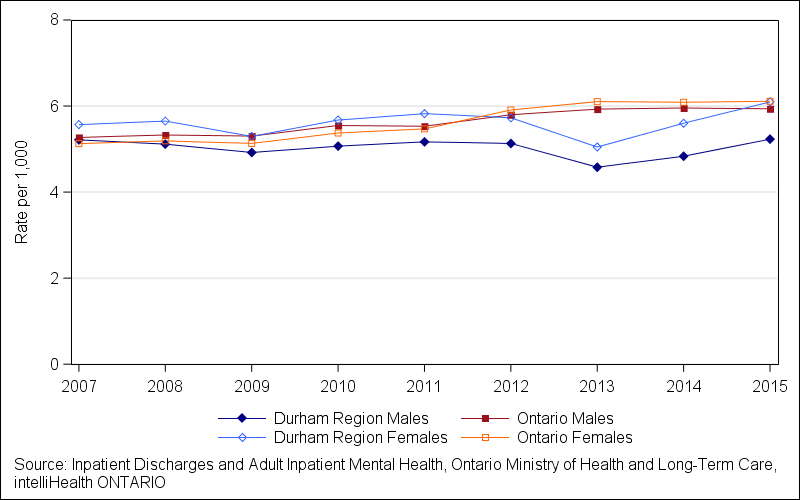
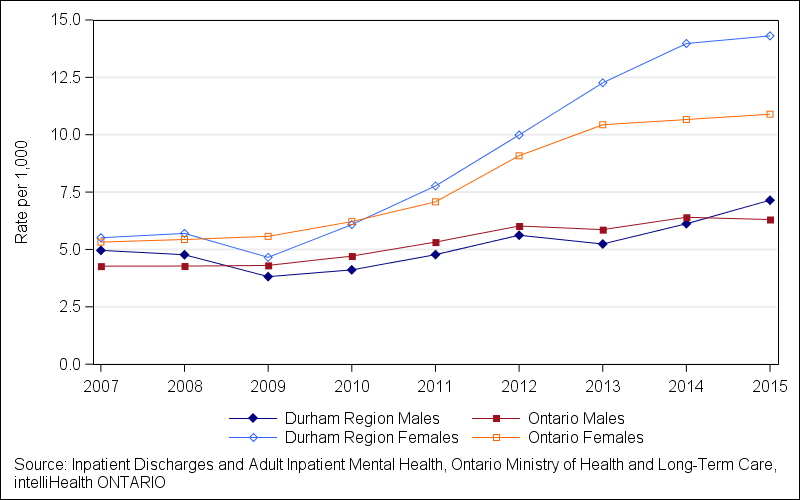
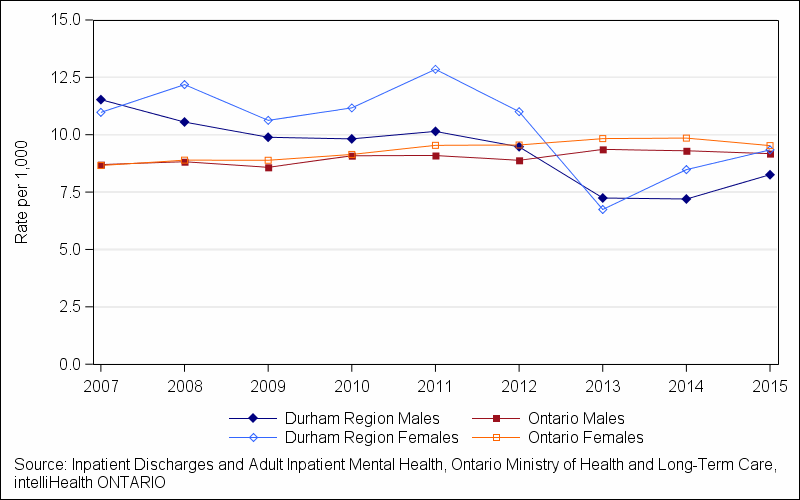
The number of individuals with at least one hospitalization (such as being discharged from a general hospital or admitted to a designated acute mental health bed) per 1,000 population for the same year that would have occurred if the population had the same age distribution as the 2011 Canadian population.
Age-specific prevalence of mental illness hospitalizations
The number of individuals with at least one hospitalization (such as being discharged from a general hospital or admitted to a designated acute mental health bed) in a specified age group per 1,000 population in that age group for the same year.