

Tick-Borne Diseases
Durham Region Health Department works to prevent and reduce the spread of tick-borne diseases in humans through tick surveillance, public health promotion and the investigation of human cases.
Tick-borne disease incidence is rising in Durham Region as tick populations are now established throughout the Region. Climate change, resulting in longer seasons of warm weather, is increasing the number of blacklegged ticks (Ixodes scapularis) in our environment. Blacklegged ticks can transmit diseases such as Lyme disease, anaplasmosis, babesiosis, and Powassan virus. Tick-borne diseases cannot spread from person to person.
Lyme disease in Durham Region infographic Vector-borne diseases report infographic
Protecting yourself from tick bites
- Wear long pants and long sleeves.
- Wear light coloured clothing so that ticks are easier to spot.
- Apply an insect repellent containing DEET or Icaridin and follow the application instructions on the product label.
- After spending time outdoors in wooded or brushy areas:
- remove outdoor clothing as soon as you come indoors and put the clothes immediately into a hot dryer, for at least 15 minutes, prior to washing them,
- check your full body, including your children and pets for ticks and shower within one to two hours to remove ticks before they can attach to the skin.
- If you find a tick, remove it as soon as possible and clean and disinfect the bite area to help prevent infection.
Tick identification
eTick.ca is a public platform for image-based identification and population monitoring of ticks in Canada. They provide a free online surveillance program where residents who identify a tick on themselves, their pets, or in the environment can submit a photo of the tick for identification.
How to remove a tick
If you find a tick, remove it as soon as possible.
- Remove it gently with fine-tipped tweezers.
- Do not squeeze, try to burn it off, or spray it with insect repellent.
- Grab the tick as close to skin as possible.
- Pull the tick away from skin gently, but firmly.
- Place the tick into a tightly closed container.
- Clean and disinfect the bite area to help prevent infection.

If you find a tick on a person
- Remove the tick immediately, then clean and disinfect the bite area to help prevent infection.
- It’s important to contact your health care provider if the tick was likely attached for at least 24 hours or if you develop any symptoms after being bitten.
- Additionally, you can consult your local pharmacist to see if they prescribe prophylactic antibiotics for Lyme disease and if you are eligible to receive them.
- Be sure to tell the doctor about your recent tick bite, when the bite occurred, and where you most likely acquired the tick.
- Blacklegged ticks are usually found in or near wooded or forested areas, in leaf litter, or on bushes and tall grass.
- Ticks need blood to survive and they can become infected when they feed on infected wild animals such as birds, rodents or deer. Only then can they spread the infection to humans or pets.
- Blacklegged ticks are very small. Immature ticks can be the size of a poppy seed and adults the size of a sesame seed.
- They often attach to areas of the body where they are hard to see, such as the groin, armpit and scalp.
- Ticks cannot fly or jump. Instead, they climb onto grasses or bushes and wait for a host (person or animal) to brush by. A tick will quickly attach and then find a suitable place to bite.
Tick-borne diseases of public health significance
Anaplasmosis
Anaplasmosis is a bacterial infection transmitted through the bite of an infected blacklegged tick. Symptoms of anaplasmosis typically begin to show within seven and 21 days from a bite of an infected blacklegged tick.
Contact your health care professional right away if you have been somewhere that ticks might live and experience any of the following symptoms:
- fever
- chills
- severe headache
- myalgia
- abdominal pain
- nausea
- vomiting
- diarrhea
- loss of appetite
- respiratory symptoms, central nervous system issues, and a rash are sometimes reported.
If untreated, anaplasmosis usually lasts between seven and 14 days, with persistent symptoms up to 60 days. In rare cases, if treatment is delayed or other medical conditions are present, anaplasmosis can lead to serious illness, including:
- respiratory failure
- bleeding problems
- organ failure and death
Anaplasmosis diagnosis and treatment
Your health care provider may diagnose you with anaplasmosis depending on your signs, symptoms, history of possible exposure to infected ticks or travel to areas where blacklegged tick populations are established, and laboratory diagnostic testing.
Most cases of anaplasmosis can be treated successfully with antibiotics.
Babesiosis
Babesiosis is a parasitic infection transmitted through the bite of an infected blacklegged tick. Symptoms of babesiosis typically begin to show within seven and 30 days from the bite of an infected blacklegged tick, and seven days and nine weeks after a contaminated blood transfusion.
Contact your health care professional right away if you may have been exposed to ticks and experience any of the following symptoms:
- fever
- chills
- sweats
- headache
- body aches
- loss of appetite
- nausea
- fatigue
Most infections are asymptomatic, however, since Babesia parasites infect and destroy red blood cells, babesiosis can cause a type of anemia called hemolytic anemia. Symptoms of hemolytic anemia include fatigue, jaundice and dark urine.
Babesiosis diagnosis and treatment
Your health care provider may diagnose you with babesiosis depending on your signs, symptoms, history of possible exposure to infected ticks or travel to areas where blacklegged tick populations are established and laboratory diagnostic testing.
Most cases of babesiosis can be successfully treated with antibiotics and/or antiparasitic drugs.
Lyme disease
Protect yourself against Lyme disease
Lyme disease is a bacterial infection transmitted through the bite of an infected blacklegged tick. Symptoms of Lyme disease in humans usually appear between three and 30 days after a bite from an infected blacklegged tick.
You should contact your health care professional right away if you may have been exposed to ticks and experience any of the following symptoms:
- rash
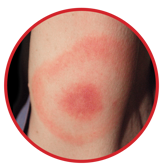
- a bull’s-eye rash (a red patch on the skin that is usually round or oval and more than five centimetres that spreads outwards and is getting bigger
- another type of unusual rash, a bruise-like rash, (usually on darker skin tones)
- fever
- chills
- headache
- stiff neck
- muscle aches and joint pain
- fatigue (more tired than usual)
- swollen lymph nodes
- spasms, numbness or tingling
- facial paralysis
If not treated, Lyme disease can cause more severe symptoms which can last years and include:
- damage to your heart, nerves, liver and joints,
- recurring arthritis and,
- neurological problems,
- numbness,
- paralysis and, in very rare cases,
- death.
Lyme disease diagnosis and treatment
Your health care provider may diagnose you with Lyme disease depending on your signs, symptoms and risk factors. Laboratory testing is not always required to diagnose and treat Lyme disease infection.
Most cases of Lyme disease can be treated successfully with antibiotics.
You can consult your local pharmacist to see if they prescribe prophylactic antibiotics for Lyme disease and if you are eligible to receive them.
Powassan virus
Powassan virus disease is a rare infection transmitted through the bite of an infected blacklegged tick, or less commonly the groundhog tick or squirrel tick. Symptoms of Powassan virus typically begin to show within seven and 30 days from a bite of an infected blacklegged tick.
Contact your health care professional right away if you may have been exposed to ticks and experience any of the following symptoms:
- fever (there may be a transient period of remission following the acute fever phase, followed by worsening neurological deterioration)
- headache
- nausea
- vomiting
- asthenia
- myalgia
Most infections are asymptomatic. However, a person may develop symptoms of severe disease, which includes:
- confusion
- loss of coordination
- difficulty speaking
- paralysis
- seizures or coma
Approximately 50 per cent of people who survive severe disease have long-term health problems, such as:
- recurring headaches
- loss of muscle mass and strength
- memory problems
Powassan virus diagnosis and treatment
Your health care provider may diagnose you with Powassan virus depending on your signs, symptoms, history of possible exposure to infected ticks or travel to areas where blacklegged tick populations are established and laboratory diagnostic testing.
There is currently no known treatment for Powassan virus.
Sign up to our Newsletter
Stay up to date on the Region's activities, events, programs and operations by subscribing to our eNewsletters.